Commercial and Industrial Designers

Low Risk
Low High

Explore safer careers (2)

Lower estimated automation risk

Interior Designers
20% automation risk | Low Risk
More jobs
7.3 pts lower View career
Why it fits

Applies materials, ergonomics, color, finishes, client needs, spatial constraints, and presentation boards.

Set and Exhibit Designers
20% automation risk | Low Risk
7 pts lower View career
Why it fits

Uses spatial form, materials, fabrication constraints, prototypes, visual storytelling, and client presentation.

Alternative careers

Related career paths that build on similar skills and experience

Industrial Engineers
28% automation risk | Low Risk
Pays better Higher growth
View career
Why it fits

Fits designers with manufacturing focus using workflow constraints, ergonomics, productivity data, layouts, and process improvement.

Art Directors
22% automation risk | Low Risk
Pays better More jobs
5 pts lower View career
Why it fits

Fits experienced designers using visual direction, concepts, brand standards, creative teams, reviews, and client approvals.


Share your results with friends and family.

Occupation snapshot

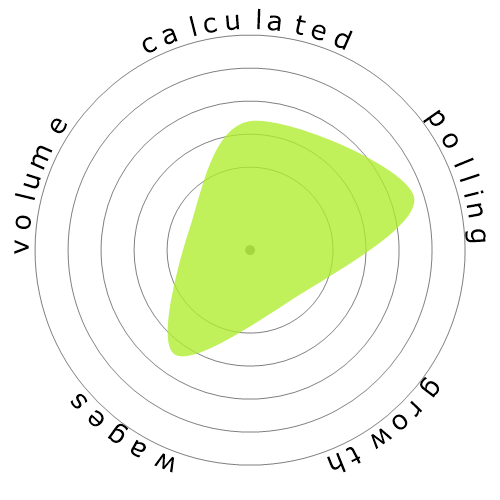
What does this snowflake show?
The Snowflake is a visual summary of the five badges: Automation Risk (calculated), Risk (polled), Growth, Wages and Volume. It gives you an instant snapshot of an occupations profile. The colour of the Snowflake relates to its size. The better the occupation scores in relation to others, the larger and greener the Snowflake becomes.
JOB SCORE
5.9/10
What's this?
Job Score (higher is better):

We rate jobs using four factors. These are:

- Chance of being automated
- Job growth
- Wages
- Volume of available positions

These are some key things to think about when job hunting.

Risk & user votes

Calculated automation risk

27% (Low Risk)

Low Risk (21-40%): This occupation has a lower risk of full replacement by AI, software, or robotic systems. Some tasks may be automated or assisted, but the role usually still relies on human judgement, communication, responsibility, physical adaptability, or practical decision-making.

More information on what this score is, and how it is calculated is available here.

Human strengths important in this job

These are human abilities and work contexts that are important in this occupation. They may help explain why parts of the role are harder to replace end-to-end, but they are not the only inputs into the automation score.

Decision-making and problem solving

Very important
Why this matters
Analyze information, weigh tradeoffs, and choose the best solution—especially when situations are ambiguous, high-stakes, or have real-world consequences.
Jobs that also use this strength

Thinking creatively

Quite important
Why this matters
Coming up with original ideas and designs—creating new concepts, products, systems, or artistic work. This kind of open-ended invention and taste-based judgment is harder to automate end-to-end than routine, rule-based tasks.
Jobs that also use this strength

Persuasion

Quite important
Why this matters
Influencing people to change their minds or behavior through conversation, trust, and negotiation.
Jobs that also use this strength

Social perceptiveness

Quite important
Why this matters
Noticing others’ emotions and reactions in the moment and adjusting what you say or do based on why they’re responding that way.
Jobs that also use this strength

Communicating with people outside the organization

Quite important
Why this matters
Represents the organization to customers, the public, or government—handling questions, concerns, and relationship-building through conversations, writing, calls, or email.
Jobs that also use this strength
Show 2 more strengths

Active learning

Quite important
Why this matters
Keeps learning from new information and applying it to make better decisions now and in the future, especially when situations change.
Jobs that also use this strength

Operations analysis

Quite important
Why this matters
Figure out what people need and what a product must do, then translate those requirements into a workable design.
Jobs that also use this strength

What users think

Based on 203 votes

32% chance of full automation within the next two decades

Our visitors have voted there's a low chance this occupation will be automated. This assessment is further supported by the calculated automation risk level, which estimates 27% chance of automation.

What do you think the risk of automation is?

What is the likelihood that Commercial and Industrial Designers will be replaced by robots or artificial intelligence within the next 20 years?

Sentiment

Based on user votes over time

View sentiment trend

How opinions have changed over time

Pay & outlook

Wages

High paid relative to other professions

In 2024, the median annual wage for Commercial and Industrial Designers was $79,450 ($38 per hour).

The median annual wage for Commercial and Industrial Designers was 60.5% higher than the national median annual wage, which stood at $49,500.

View wage trend

Wages over time

* Data from the Bureau of Labor Statistics

Growth

Moderate growth relative to other professions

The number of 'Commercial and Industrial Designers' job openings is expected to rise 3.2% by 2034

View employment trend

Total employment, and estimated job openings

* Data from the Bureau of Labor Statistics for the period between 2023 and 2033
Updated projections are due 09-2025.

Volume

Lower range of job opportunities compared to other professions

As of 2024 there were 30,250 people employed as 'Commercial and Industrial Designers' within the United States.

This represents around < 0.001% of the employed workforce across the country

Put another way, around 1 in 5 thousand people are employed as 'Commercial and Industrial Designers'.

People also viewed

Graphic Designers Web Developers Computer Programmers Lawyers Actors

What people are saying (18)

Leave a comment
incandescent_waller (Low)
20 Sep 2024 13:18
The thing more requires originality, something hard for AI to achieve
Özgür Taylan Çelik
20 Jul 2025 09:49
It is not that hard for AI to understand analogies. That means connecting dots is something doable for AI. Doesn't that mean a creativity?
Ian D. Velázquez (Low)
07 Aug 2023 20:56
AI will never have the social awareness and emocional human understanding to replace an industrial designer
Oscar Humano (Low)
18 May 2023 00:16
Parameters and ideas can be shared between humans and robots. Since sensory levels are still predominantly in humans and design is based on sensations and experiences, robots need to feed on human sensations and experiences.
Nicolas
12 Feb 2023 12:42
I see how many classic "low-level" design tasks can be automated. Design agencies that specialize in the isolated styling of consumer goods for various smaller companies or brands will probably need far fewer employees in the future.

Of course, modern designers work in a multidisciplinary manner and communicate between the various fields of product development. They are not as isolated as the qualities listed above suggest, so I doubt they will become extinct too quickly.

Companies are unlikely to risk their money and reputation on AI wild shots without some form of sentient consideration. Despite this, I bet some will try it anyway, and I am honestly eager to see them succeed.

Advanced creative tasks like innovation management and the expansion of the product portfolio are too important for companies to leave exclusively to tools right now. This job will likely adapt and merge a lot more with engineering and management disciplines.

It is normal for jobs to change with technology.
Zaber (Low)
29 Jan 2023 11:41
Designing industrial products that people use every day is a complex task. It requires a lot of real-world field research, which an AI confined within the boundaries of machines cannot comprehend or execute. In my opinion, AI will certainly be a blessing for industrial designers and others. A vast amount of data can be processed with great insights in a very short amount of time, adding massive value to the work of designers.

However, the human-like quality of AI, like Chat GPT3 and others, is still primitive in capacity, even though their articulation is top-notch, to say the least. Even then, it is not enough to design products at the capacity that humans currently are capable of.

Certain design fields will probably struggle to reduce their dependency on humans, like graphic design, illustrations, and animation design. However, fields like product or industrial design, architecture, and the like are not likely to be replaced any time soon.

For now and in the foreseeable future, I see AI as a personal assistant to industrial designers rather than a threat.
Wnm (Highly likely)
17 Dec 2022 21:50
AI is as good as its inputs. As more data from the design world is entered, the better AI will become at generating creative solutions and output.
Zhusepe (Moderate)
05 Sep 2022 11:02
Recent developments with AI show that it's fully feasible to automate product design.

Given a certain prompt and a starting image, an AI could create thousands of designs, each better than the last one.
Alex (Low)
30 Aug 2022 21:49
Automation will streamline the process for industrial design. So, while companies might hire fewer designers to accomplish the same output of work, the work itself will never be completely automated. This is due to how fundamental the product is to the bottom line of a company's profit.

New CAD tools will optimize and speed up the development process. Consequently, companies will hire fewer employees and expect more from them. This could lead to worker burnout and exploitation becoming even more common, due to the limited staff.

Prospective employees, in addition to having exceptional artistic skills, will also be expected to have proficiency in programming.
Nitin (Uncertain)
11 Jun 2021 22:48
Industrial design is both about beauty and function. We have tools already that could simulate and rank the functional efficiencies. Data science could play a role in outlining the patterns of large-scale users' likings, which individual designers might not be able to do.
Oscar Os
05 Nov 2020 20:31
En ingles o español creo que no se entiende que es una profesión que tiene muchos factores que difícilmente se pueden generar algoritmos, el arte a mi parecer es la ultima línea de los algoritmos, el diseño industrial contempla Ciencias y artes. Tan lógico como que cualquiera puede tener una propuesta a muchos requerimientos en la industria. In English or Spanish I think it is not understood that it is a profession that has many factors that it is difficult to generate algorithms, art in my opinion is the last line of algorithms, industrial design contemplates Sciences and arts. As logical as that anyone can have a proposal to many requirements in the industry.
Raúl Palafox
20 May 2020 05:38
industrial design could be developed by robots till the algorithms decide how we should love
Marco (No chance)
27 Apr 2020 15:56
Design is an art, it's subjective, there's no way a machine can replace this job.
Omar
04 Mar 2021 06:00
What? I know that some of the young graphic designers and some students consider themselves artists but you should know that that isn't art. Some types of design use elements of art, but that doesn't make it art.
w
14 Jul 2022 12:48
Graphic design isn't the same as industrial design. Yes, it is an art in many ways.

In my humble opinion, it falls under creative technology. It doesn't matter what you are actually designing; you're always going to, in the end, design a new way of living.
the (Low)
01 Mar 2020 02:08
creation of original ideas is one of the few things that I see machines having a hard time doing
Jon (Low)
10 Dec 2019 13:56
Industrial Designers could use robots or design them for automation
Alex
24 Jun 2020 17:48
not in my home

Leave a reply about this occupation
0/8000

Job description

Design and develop manufactured products, such as cars, home appliances, and children's toys. Combine artistic talent with research on product use, marketing, and materials to create the most functional and appealing product design.

O*NET-SOC code: 27-1021.00